Search engine optimization has changed dramatically over the past few years. The era of stuffing a webpage with keywords and waiting for Google to reward you is firmly in the past. Today, artificial intelligence drives how search engines understand content, rank pages, and connect users to answers.
If your business still relies solely on traditional keyword targeting, you are already falling behind. Understanding how AI reshapes search is no longer optional. It is the foundation of every successful AI SEO strategy for business in 2026 and beyond.
Why Keywords Alone No Longer Define SEO
For decades, keywords were the backbone of SEO. Marketers researched the exact phrases people typed into search bars and built pages around those exact matches. Google has moved far beyond that model.
Google now uses machine learning systems, including BERT, MUM, and the Helpful Content system, to understand the meaning and context behind a search query rather than just the words themselves. This shift means search engines evaluate topics, intent, expertise, and trustworthiness rather than keyword frequency.
As a result, businesses that partner with the best AI SEO agency are investing in content strategies built around user intent, topical authority, and semantic relevance rather than isolated keyword lists.
What AI-Powered SEO Actually Means
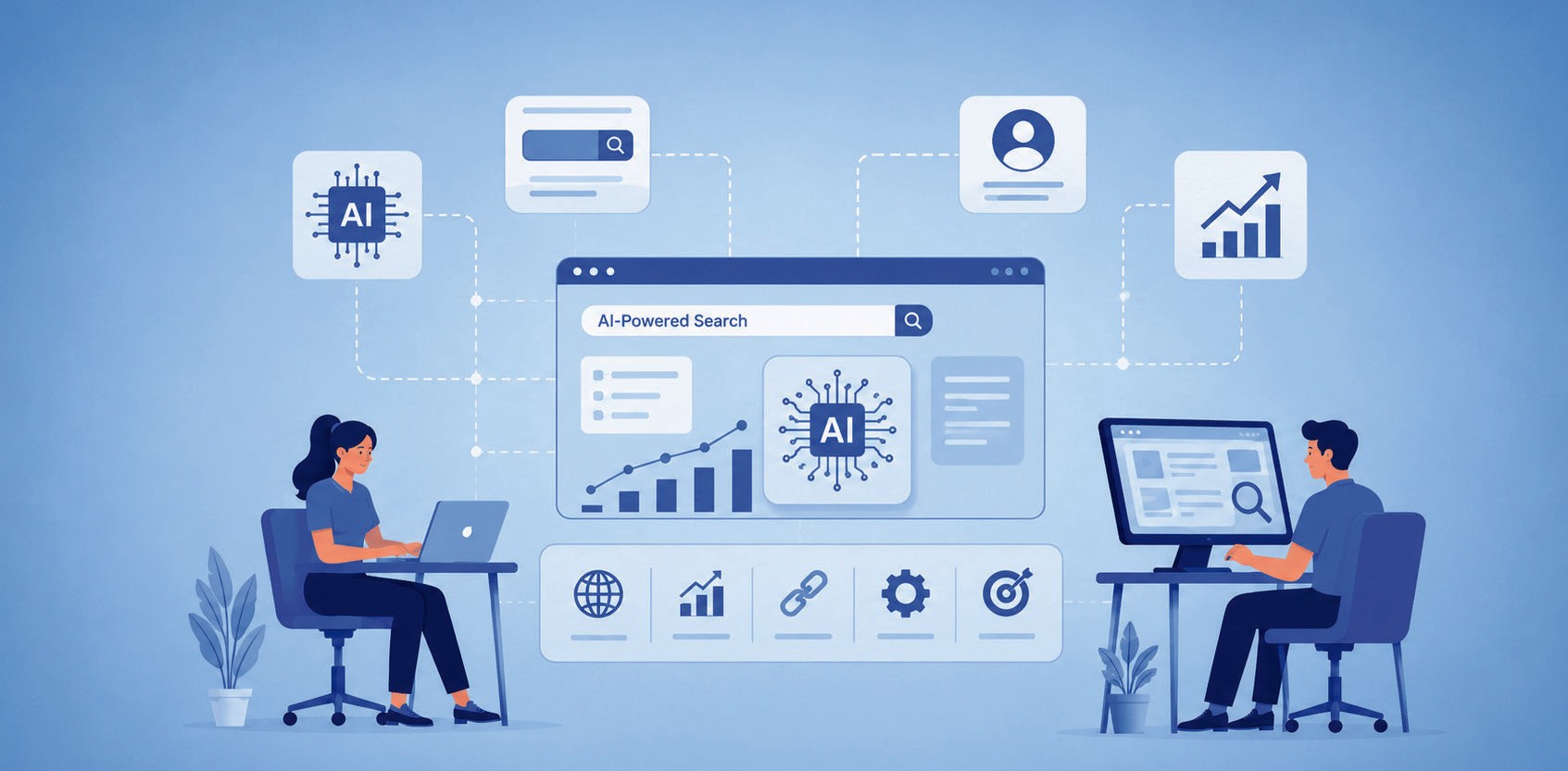
AI-powered SEO is the practice of using artificial intelligence, both within search engines and as a tool for SEO practitioners, to create smarter, more effective optimization strategies. It covers several interconnected areas.
Pillar | Type | What It Means |
Natural Language | Core | Search engines parse sentence meaning, not just keywords, matching content to conversational and voice queries. |
Intent Mapping | Core | AI identifies whether a user wants information, a comparison, or a purchase, and ranks content that matches that intent. |
Predictive Analysis | Advanced | AI tools analyze trends and competitor gaps before they peak, enabling businesses to publish content at the right moment. |
E-E-A-T Signals | Trust | Experience, Expertise, Authoritativeness, and Trustworthiness are assessed algorithmically for every page. |
How Google AI Overviews Are Changing Visibility
One of the most visible shifts in modern search is Google's AI Overviews, which now appear at the top of many search results. These AI-generated summaries pull information directly from web pages, meaning that businesses need to structure their content so AI can easily extract and cite it.
This is where professional AI SEO services make a real difference. Instead of simply optimizing for blue link rankings, today's SEO work involves optimizing for AI citation, featured snippet placement, and structured data markup that helps search engines parse your content accurately.
Businesses that adapt their content structure to meet these new requirements will earn visibility both in traditional results and in AI-driven answer formats, doubling their organic reach without doubling their budget.
# | Old SEO Model | AI SEO Model | Impact |
1 | Keyword stuffing | Semantic topic clusters | Broader topical authority over isolated keyword matches |
2 | Exact match focus | Search intent mapping | Content aligned to what users actually want, not just what they type |
3 | Page-level optimization | E-E-A-T optimization | Site-wide trust and expertise signals recognized algorithmically |
4 | Link count only | Authority signals | Quality and relevance of links weigh more than raw quantity |
5 | Declining results | Consistent growth | AI-first strategies compound over time vs. keyword tactics that plateau |
Building an Effective AI SEO Strategy for Business
Transitioning to an AI-first SEO approach does not mean abandoning everything you know. It means layering smarter thinking on top of your existing foundation. Here is a practical framework that leading AI SEO services providers use today.
Build topic clusters, not keyword silos
Group related content around a central pillar page and interlink supporting articles. This signals topical depth to AI-driven algorithms and earns authority faster than isolated keyword pages.
Optimize for search intent above keyword density
Identify whether your target query is informational, navigational, or transactional. Then structure your content to satisfy that intent completely, not just mention the keyword repeatedly.
Implement structured data markup
Schema markup helps search engines extract key facts from your pages for AI Overviews, rich snippets, and knowledge panels. This is a critical layer of any modern SEO beyond keywords service.
Strengthen E-E-A-T signals across your site
Publish author bios, cite credible sources, earn quality backlinks, and keep content regularly updated. These signals communicate expertise and trustworthiness to both users and algorithms.
Use AI tools for content gap analysis
AI-powered platforms like Semrush, Ahrefs, and Clearscope identify topics your competitors cover that you do not. Closing these gaps drives faster rankings and broader topical coverage.
The Role of the Best AI SEO Agency in Your Growth
Implementing a comprehensive AI SEO strategy requires more than a tool subscription. It demands strategic thinking, technical execution, and ongoing content production working in sync. For most businesses, partnering with the best AI SEO agency is the most efficient path to results.
A qualified agency brings three layers of value. First, it audits your current SEO health and identifies AI-era gaps that traditional audits miss. Second, it builds a custom roadmap aligned with your business goals, search trends, and competitive landscape. Third, it executes consistently, measuring performance against benchmarks and adapting the strategy as algorithms evolve.
Trying to manage modern AI-driven SEO in-house without specialist knowledge often leads to slow results, technical oversights, and wasted content budgets. The investment in expert guidance pays back through compounding organic growth over time.

What Makes an SEO Beyond Keywords Service Different
A true SEO beyond keywords service treats your website as a knowledge asset, not just a collection of optimized pages. It focuses on building authority, earning trust, and delivering content that genuinely serves the user at every stage of their journey.
Semantic SEO and entity optimization
Modern search engines use entity-based understanding. This means Google maps relationships between concepts, people, brands, and places. Optimizing for entities, not just keywords, positions your brand within Google's knowledge graph and boosts visibility across a broader range of related queries.
Voice and conversational search readiness
Over 50% of searches are now conversational or voice-based. AI SEO services structure content to answer natural language questions directly, increasing your chances of appearing in voice search responses and AI-generated summaries.
Core Web Vitals and technical AI compatibility
Search AI favors pages that load fast, are mobile-friendly, and deliver a smooth user experience. Technical SEO remains critical, but it now exists alongside content quality, not separately from it.
Frequently Asked Questions
What are AI SEO services and how do they differ from traditional SEO?
AI SEO services use artificial intelligence tools and AI-era best practices to optimize content for intent, entities, and semantic relevance rather than just keywords. They go beyond page-level optimization to build topical authority and AI citation readiness.
How does Google's AI affect my website rankings?
Google's AI systems, including BERT, MUM, and the Helpful Content system, evaluate the depth, relevance, and trustworthiness of your content. Pages that demonstrate E-E-A-T and satisfy full search intent rank higher than pages optimized only for keyword density.
Is an AI SEO strategy for business suitable for small companies?
Yes. In fact, smaller businesses often benefit more from AI-driven strategies because they can build topical authority in a specific niche faster than trying to compete for broad, high-volume keywords against large competitors.
How long does it take to see results from AI-powered SEO?
Most businesses see measurable improvements within 3 to 6 months. Technical fixes and structured data improvements can show results sooner, while content authority and backlink strategies typically take 4 to 9 months to compound into significant traffic gains.
What should I look for in the best AI SEO agency?
Look for agencies that demonstrate clear knowledge of AI-era ranking factors, offer transparent reporting, provide case studies from your industry, and can articulate a strategy beyond basic keyword research. Avoid agencies that guarantee specific rankings within unrealistic timeframes.
Does AI SEO replace the need for content creation?
No. AI tools assist with research, gap analysis, and optimization guidance, but high-quality, original content created by human experts remains the most important ranking factor. AI supports the content strategy; it does not replace genuine expertise and real-world experience.
Reviewed by: TechInfinity Content Team
Last Updated:
This article follows our Editorial Policy and Content Review Process to ensure accuracy and relevance.