Search is no longer just about typing a query and scrolling through ten blue links. In 2026, artificial intelligence has fundamentally changed how people discover information online. Tools like ChatGPT, Google AI Overviews, and Perplexity now answer questions directly, pulling content from trusted sources without the user ever clicking a traditional result.
This shift has given rise to a powerful new discipline called Generative Engine Optimization, or GEO. If you run a business and rely on organic traffic, understanding the difference between traditional GEO vs SEO is no longer optional. It is essential for survival in the AI-first search era.
What Is Generative Engine Optimization?
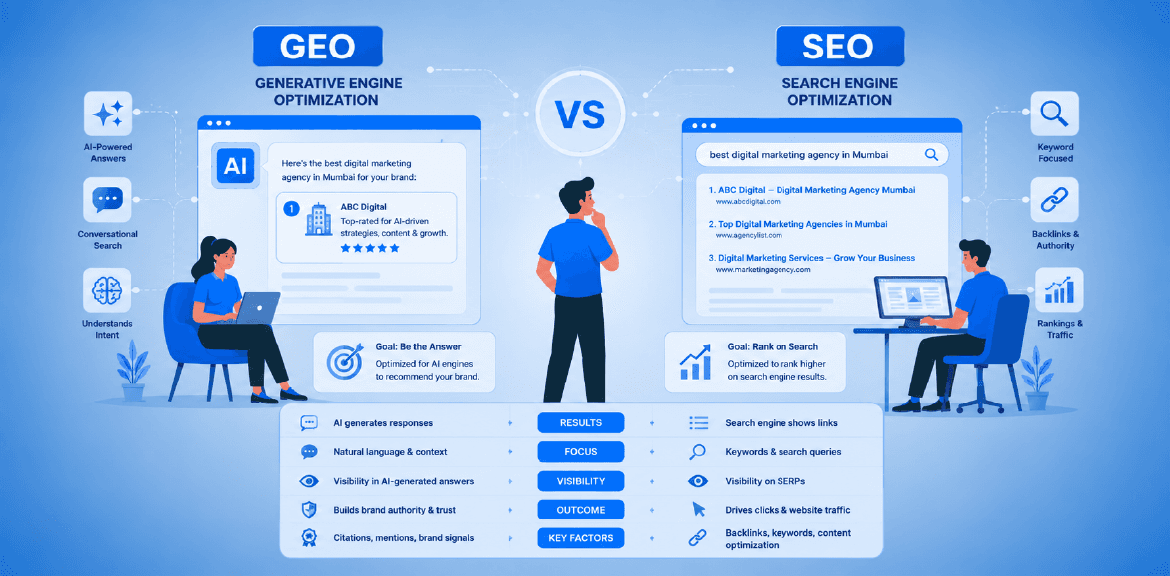
Generative Engine Optimization is the practice of structuring and positioning your content so that AI-powered search engines choose it as a trusted source in their generated answers. Unlike traditional SEO, which focuses on ranking on a results page, GEO focuses on getting your content cited, quoted, or referenced inside AI-generated responses.
Think of it this way. When someone asks ChatGPT "what is the best SEO agency in Mumbai," the AI does not show ten links. It synthesizes an answer from sources it considers authoritative. GEO is the strategy that gets your business into that answer.
GEO vs SEO: Understanding the Core Differences
Before diving into tactics, it helps to understand exactly how traditional GEO vs SEO compares across the key dimensions that matter to your business.
Dimension | Traditional SEO | Generative Engine Optimization (GEO) |
Primary Goal | Rank on Google page 1 | Get cited in AI-generated answers |
Key Tactics | Keywords, backlinks, meta tags | Topical authority, E-E-A-T, structured content |
User Journey | User clicks a link to reach content | User gets the answer without clicking |
Success Metric | Organic traffic volume | Brand mentions in AI responses |
Content Format | Long-form, keyword-rich pages | Clear, concise, citable passages |
Update Cycle | Monthly algorithm updates | Real-time model training and indexing |
Era | 2010 to 2024 | 2025 onwards |
How GEO Works in AI Search Engines
AI search engines use a process called retrieval-augmented generation (RAG) to pull relevant passages from the web and synthesize them into answers. Here is how the process works step by step:
Step 1: Query Interpretation
The AI breaks down the user's intent, not just the keywords, to understand exactly what kind of answer is needed. Intent recognition is the foundation of every AI-generated response.
Step 2: Source Retrieval
The model scans its index and crawled content to find pages that match the intent with high confidence and authority. Pages that are well-structured and trusted by the web rank higher in this retrieval step.
Step 3: Passage Extraction
The AI pulls specific paragraphs or sentences that directly answer the query. Structured, concise writing wins at this stage. Vague or keyword-heavy paragraphs get ignored.
Step 4: Answer Synthesis
The model generates a response using the extracted passages, often citing the original source as a reference. This is the moment GEO is designed to capture.
Step 5: Trust Weighting
Sources with established E-E-A-T signals receive higher citation priority. Experience, Expertise, Authoritativeness, and Trustworthiness are the four pillars AI models rely on to decide which content to feature.
Five Pillars of a GEO Strategy
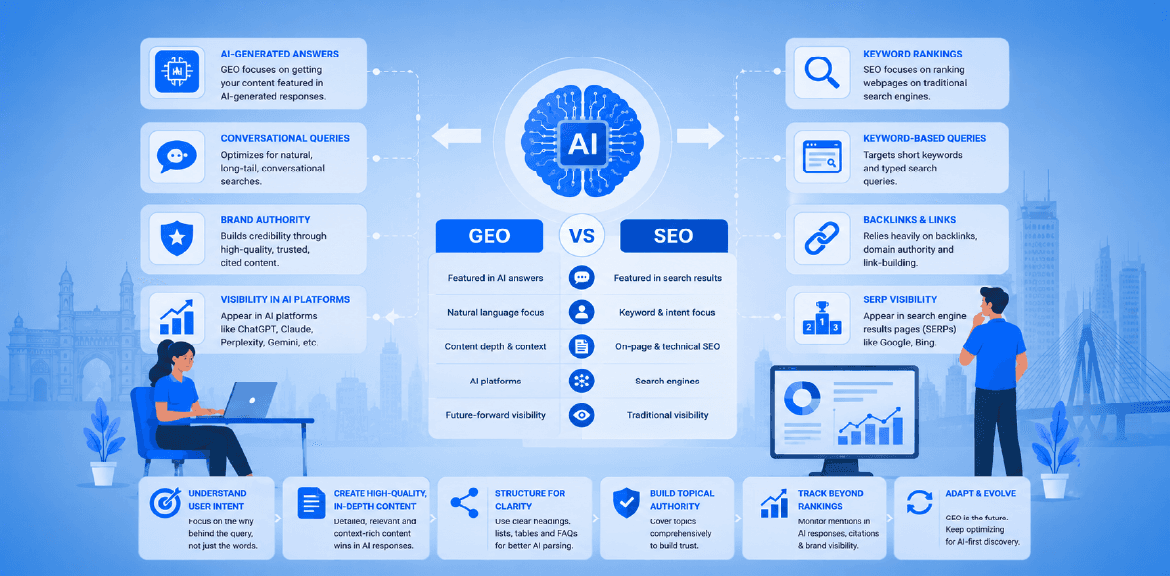
To build a GEO strategy that earns AI citations consistently, focus on these five foundational pillars:
• Topical Authority: Cover topics deeply, not just broadly. Build content clusters around your niche so AI models see you as the definitive source.
• Structured Content: Use FAQ schema, How-To markup, and clear H2/H3 headings that make it easy for AI to extract passages.
• E-E-A-T Signals: Include author credentials, earn mentions on reputable websites, and keep your business information consistent across directories.
• llms.txt File: Create an llms.txt file to guide AI crawlers to your best and most citable content pages, similar to robots.txt for traditional crawlers.
• Brand Mentions: Get cited on forums, Reddit, review sites, and industry blogs that AI models trust and regularly crawl.
Does Traditional SEO Still Matter in 2026?
Yes, but its role has shifted. Traditional SEO and GEO are not opposites. They work best together. A well-structured website with strong technical SEO gives GEO strategies a solid foundation to build on.
Google still drives significant traffic through its classic search results, especially for local, transactional, and product-based queries. However, businesses that rely exclusively on traditional keyword rankings without adapting to AI-driven search are already losing visibility.
The future of SEO in 2026 belongs to brands that master both disciplines simultaneously.
What This Means for Businesses in Mumbai
For any business working with a search engine optimization agency in Mumbai, the conversation has evolved. It is no longer enough to rank for "best digital marketing agency Mumbai" on page one. Your agency needs to ensure your brand is also appearing inside AI-generated answers when potential clients ask tools like ChatGPT or Perplexity for recommendations.
As a leading SEO agency in Mumbai, Techinfinity has already integrated GEO into every client strategy. We optimize content for AI citation readiness, build topical authority clusters, implement structured schema, and create llms.txt files that guide AI crawlers to your most valuable pages.
How to Start Your GEO Strategy Today
Audit your existing content for AI-readiness
Review your top pages and ask: does this content directly answer a specific question in clear, structured language? If not, rewrite it with FAQ sections, short paragraphs, and definitive statements AI models can extract easily.
Build topical authority, not just traffic
Create content clusters that cover your niche deeply. An AI model trusts a website that has ten in-depth articles on a topic far more than one that has a single generic page optimized for a popular keyword.
Strengthen your E-E-A-T signals
Add author bios with credentials, earn mentions on reputable websites, and ensure your business information is consistent across Google Business Profile, directories, and industry review platforms.
Create an llms.txt file
Similar to robots.txt for traditional crawlers, an llms.txt file tells AI models which pages on your site are most authoritative and worth citing. This is one of the fastest GEO wins available to businesses right now.
GEO vs SEO: Frequently Asked Questions
Q. What is the difference between GEO and traditional SEO?
A. Traditional SEO focuses on ranking pages in Google's blue-link results. GEO focuses on getting your content cited inside AI-generated answers from tools like ChatGPT, Gemini, and Perplexity. Both matter in 2026, but GEO is growing faster.
Q. How does Generative Engine Optimization work in AI search engines?
A. AI search engines use retrieval-augmented generation to pull relevant passages from trusted web sources and synthesize answers. GEO ensures your content is structured, authoritative, and clearly citable so AI models select it as a source.
Q. Is traditional SEO dead in 2026?
A. No. Traditional SEO still drives significant traffic, especially for local and transactional searches. However, businesses must now pair it with GEO to maintain visibility across both classical search results and AI-generated answers.
Q. How long does it take to see results from GEO?
A. GEO results can appear faster than traditional SEO in some cases, especially if your content is already strong and you add structural improvements. Most businesses see measurable AI citation growth within 60 to 90 days of a focused GEO strategy.
Q. What is the future of SEO in 2026 and beyond?
A. The future belongs to brands that build genuine topical authority, earn trust signals across the web, and create content that AI engines can confidently cite. GEO will continue growing in importance as AI search usage increases globally.
Q. Can a Mumbai-based business benefit from GEO?
A. Absolutely. When users ask AI tools for recommendations related to services in Mumbai, GEO-optimized content significantly increases the chances of your business being mentioned. A skilled SEO agency in Mumbai with GEO expertise can build this visibility for you.
Reviewed by: TechInfinity Content Team
Last Updated:
This article follows our Editorial Policy and Content Review Process to ensure accuracy and relevance.