Campaign timelines used to stretch across six to eight weeks concept, copy, design, revisions, approvals, then finally production. Today, an AI campaign production agency can compress that same workflow into 10 to 14 days without cutting creative quality. That shift isn't hype. Agencies that adopted structured AI workflows in the past two years report production speed increases of 40-60%, according to internal case studies shared across the industry. This piece breaks down exactly how that speed comes from the ground up, and what tools make it possible.
Why Campaign Speed Became the New Competitive Edge
Brands don't just want good creative anymore they want it fast, tested, and ready to scale across ten formats by Friday. Social platforms cycle trends in days, not months, so speed up campaign production with AI has moved from a nice-to-have to a client expectation. Agencies still running fully manual pipelines are losing pitches to leaner teams who can turn a brief into a full campaign kit in under two weeks.
This is also why more brands actively search to hire AI-powered creative agency partners instead of traditional shops. It's not about replacing creative direction it's about removing the repetitive 70% of production work (resizing, drafting variations, transcribing feedback) so strategists and designers spend their time on the 30% that actually needs a human eye.
Where AI Actually Fits in the Production Pipeline
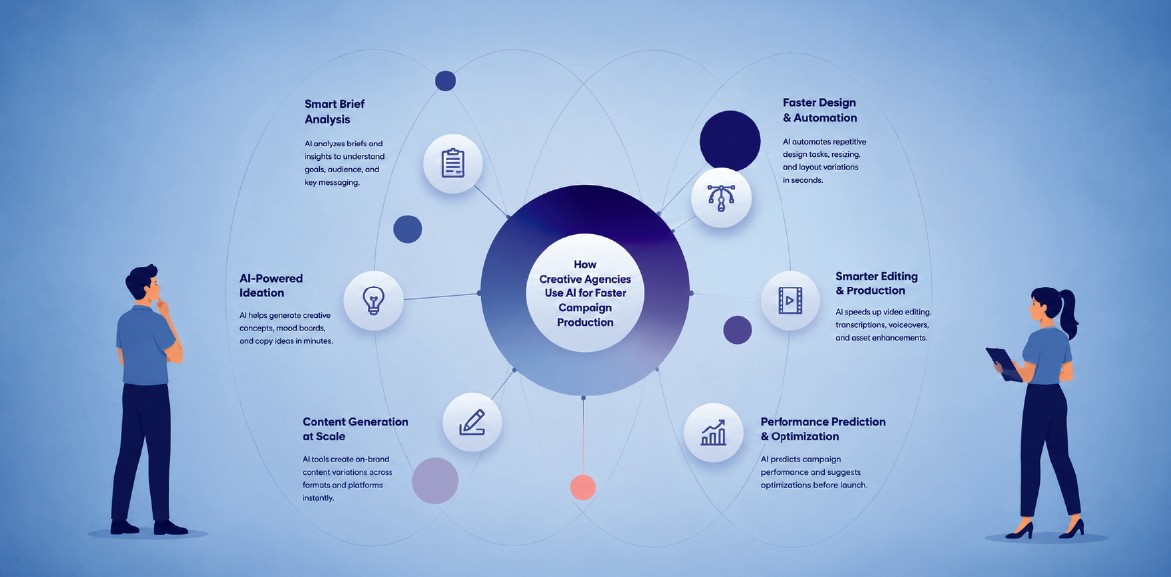
The best agencies don't bolt AI onto one stage they build it into every phase of a campaign.
1. Briefing and Concept Development
AI tools now parse client briefs, prior campaign data, and audience research to generate first-pass concept directions in hours instead of days. This doesn't replace the creative team's ideation — it gives them a stronger starting point, a shift that's reshaping how AI is changing the role of creative agencies in Mumbai far beyond just faster asset production.
2. Copywriting at Scale
Instead of one hero headline and three backups, copywriters now generate 20-30 variations per platform in a single session, then edit down to the strongest five. This is one of the most widely adopted AI tools for creative agencies because the ROI is immediate — less time drafting, more time refining tone and brand voice.
3. Visual Asset Production
Generative image and video tools handle first-draft visuals, background removal, format resizing (9:16, 1:1, 16:9), and localization variants. A single hero asset can now become 15 platform-specific versions in under an hour, a task that used to take a design team most of a day.
4. Feedback and Revision Cycles
AI-assisted feedback tools summarize stakeholder comments across email threads, Slack, and shared docs into a single prioritized revision list. This alone removes one of the biggest hidden time drains in campaign production chasing down scattered feedback.
The Tools Actually Driving This Shift
Most agencies aren't using one all-in-one platform. They're stacking a few specialized tools:
Generative copy and ideation tools for headline and script variation
Generative image/video tools for first-draft visuals and rapid resizing
AI-powered project trackers that flag bottlenecks before they delay a launch
Feedback summarization tools that turn messy client notes into clear action items
Localization tools that adapt one campaign into multiple markets simultaneously
Agencies pairing these tools with a strong AI-first process are the same ones outperforming in performance marketing, where AI vs human strategy is being worked out in real time because the tools only work as fast as the process around them.
What Doesn't Change: Strategy and Judgment
It's worth being direct about this AI speeds up production, not strategy. The agencies getting the best results still lead with a strong creative brief, clear brand positioning, and a human editor reviewing every AI-assisted output before it goes near a client. The agencies that skip that step end up with generic, off-brand work that actually costs more time to fix. If you're evaluating whether to bring this in-house or choose an SEO agency vs a freelancer style of setup for your creative work, this is usually the deciding factor teams without a strong creative lead structuring the process rarely see the speed gains agencies report.

What to Ask Before You Hire an AI-Powered Creative Agency
If you're a brand evaluating partners, a few questions separate agencies that genuinely use AI well from those bolting it on for marketing:
Which specific stages of production use AI, and which stay fully human?
What's their average turnaround time from brief to final assets?
How do they handle brand voice consistency across AI-generated copy?
Can they show a before/after production timeline from a real campaign?
Agencies with solid answers here are usually the ones already running mature workflows, not just experimenting.
The Bottom Line
The agencies winning right now aren't the ones using the most AI tools they're the ones using the right tools at the right stage, with human strategists still steering the ship. If your current production timeline feels too slow for how fast your market moves, that's usually a process problem AI can solve, not a talent problem. Start by mapping where your team spends the most repetitive hours, then layer in tools at that exact stage.
Reviewed by: TechInfinity Content Team
Last Updated:
This article follows our Editorial Policy and Content Review Process to ensure accuracy and relevance.