Most businesses publish content regularly but still struggle to rank. The reason is rarely a lack of effort. It is a lack of structure. Publishing isolated blog posts without a connecting strategy is like building rooms without a floor plan. Each piece exists on its own, and none of them carries the weight needed to rank well.
A skilled content ecosystem SEO agency approaches content differently. Instead of creating individual pages, it builds an interconnected system where every piece of content supports the others, signals topical authority to search engines, and guides users naturally through the buyer journey.
This article explains exactly how that system works and why it is the most effective long-term SEO strategy available today.
What is a content ecosystem?
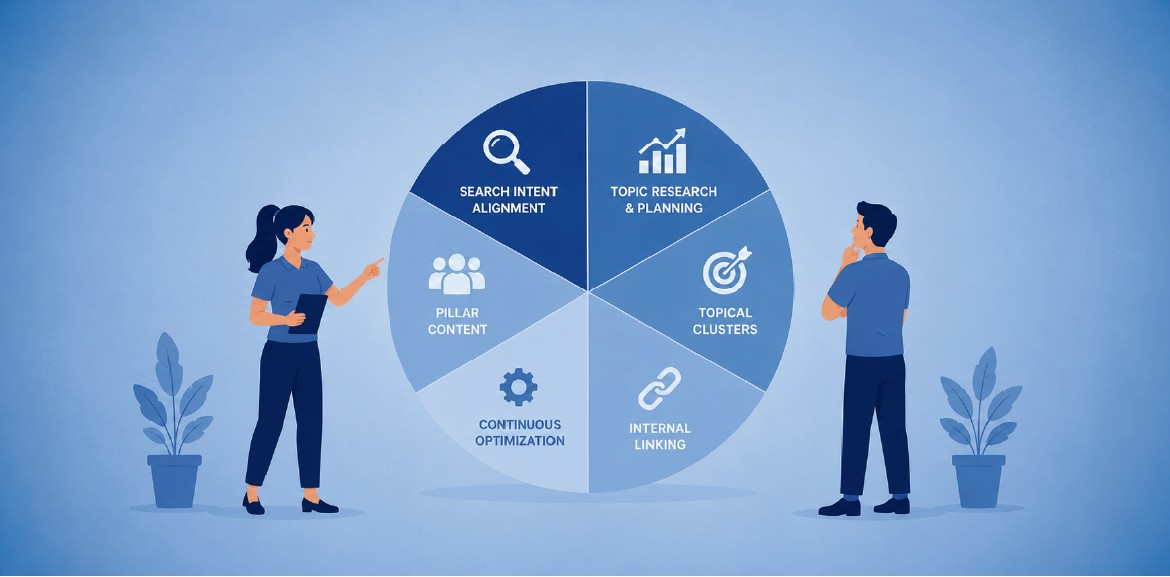
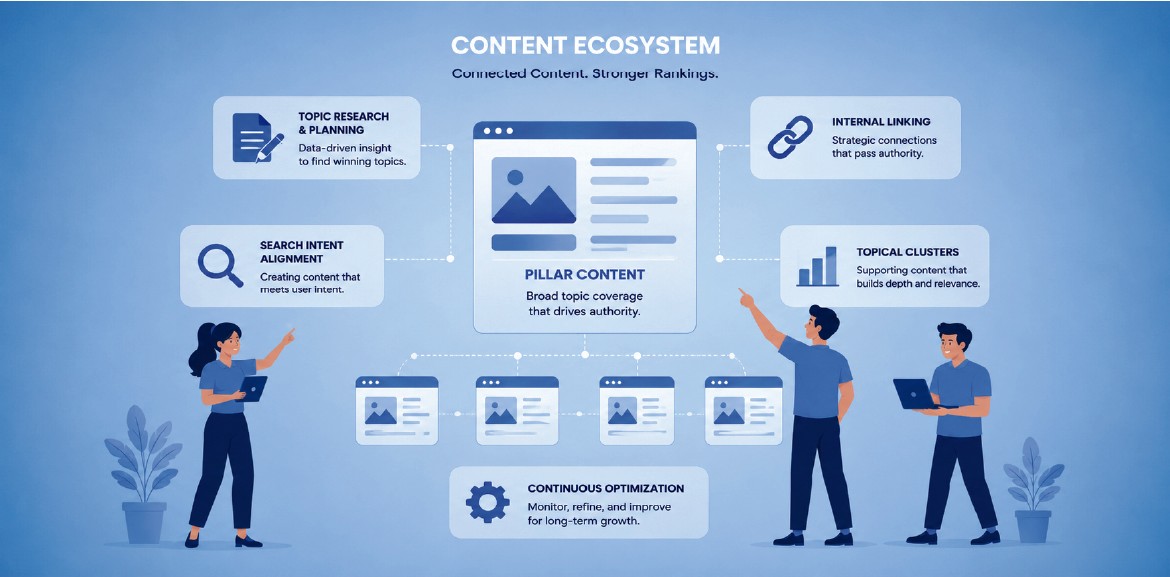
A content ecosystem is a structured network of interlinked content pieces built around a central topic. It typically includes a pillar page, a set of cluster articles, supporting blog posts, FAQs, case studies, and landing pages, all connected through a deliberate internal linking strategy.
The goal is to signal to Google that your website is the most comprehensive and authoritative source on a given subject. When search engines see that your content covers a topic from multiple angles with clear internal connections, they reward that depth with higher rankings across all related queries.
How a content ecosystem SEO agency builds the structure
When you decide to hire an SEO agency for content strategy, the first thing a professional team does is map the landscape before writing a single word. Here is how that process works in practice.
Topic and keyword research
The agency identifies the core topics that matter most to your audience and your business. It maps search volume, keyword difficulty, and user intent across hundreds of related queries to find the best entry points for content creation.
Pillar page development
The agency creates a comprehensive pillar page that covers the broad topic in depth. This page targets high-volume, competitive keywords and acts as the central hub of the cluster.
Cluster article creation
Supporting articles address specific sub-topics in detail, targeting longer-tail keywords. Each article links back to the pillar page and to related cluster pieces, creating a web of topical relevance.
Internal link architecture
Strategic internal linking distributes page authority across the ecosystem. The agency maps every link so that authority flows from high-performing pages to newer or lower-ranking content that needs a boost.
Content gap analysis and iteration
Once the initial ecosystem is live, the agency monitors rankings, identifies gaps where competitors outperform your content, and fills those gaps with new cluster articles or updated existing pieces.
The role of content cluster SEO services

Content cluster SEO services go beyond simply producing more content. They require careful planning, editorial discipline, and ongoing optimization. The difference between random publishing and a managed cluster strategy becomes visible in the data within a few months.
Without Cluster Strategy | With Cluster Strategy |
Random topic publishing | Pillar and cluster architecture |
No internal linking strategy | Deliberate internal linking |
Thin topical authority | Deep topical authority |
Stagnant or declining rankings | Compounding ranking growth |
Content budget wasted | ROI from every content piece |
Publishing without structure | Managed content cluster strategy |
Disconnected content pieces | Strategically connected content ecosystem |
Short-term and inconsistent results | Sustainable long-term organic growth |
When businesses invest in professional content cluster SEO services, they stop competing for one keyword at a time. Instead, they compete for the entire topic category. A well-built cluster can earn rankings for dozens of related queries simultaneously, multiplying the return on each piece of content produced.
What an SEO content strategy agency actually delivers
Partnering with a specialist SEO content strategy agency means you receive a complete, managed content operation rather than one-off articles. Here is what that typically includes.
Deliverable | Category | Description |
📍 Content Roadmap | Strategy | A 6–12 month publishing plan mapping every topic, keyword, content type, and publication date across the entire ecosystem. |
📄 Content Briefs | Production | Detailed briefs for each content piece, including target keywords, search-intent signals, recommended headings, word count, and competitor references. |
🔗 Link Architecture | Technical | A complete internal linking map ensuring authority flows correctly between pillar pages, cluster articles, and conversion-focused landing pages. |
📊 Performance Tracking | Analytics | Monthly reporting on rankings, organic traffic, click-through rates, and content-driven conversions, supported by actionable recommendations. |
Why businesses choose to hire an SEO agency for content strategy
Building a content ecosystem in-house is possible, but it requires a significant investment in skills, tools, and time. Most marketing teams are stretched across multiple priorities and cannot dedicate the focused attention that a structured content strategy demands.
When businesses hire an SEO agency for content strategy, they gain immediate access to experienced strategists, content writers, SEO analysts, and technical specialists working together toward a single goal. The agency brings its tooling, its processes, and its track record of building ecosystems that actually rank.
Beyond execution capacity, an agency brings an outside perspective. It identifies gaps and opportunities that internal teams often miss because they are too close to the product or service to see how their audience searches for it.
Key qualities to look for in an agency
Quality | What to look for |
Proven cluster experience | Case studies showing topic cluster builds and measurable ranking lifts over 6 to 12 months |
Transparent content planning | A clear content roadmap delivered before any writing begins, not after |
Technical SEO integration | Schema markup, internal linking, and site structure are part of the content plan, not afterthoughts |
Regular reporting | Monthly performance reports tied to specific content pieces, not just domain-level traffic numbers |
Editorial quality control | A review process that ensures every published piece meets E-E-A-T standards before it goes live |
How long does it take to see results?
Content ecosystems are a compounding asset. The first results typically appear within 3 to 4 months as search engines index and begin to evaluate the cluster structure. More significant ranking improvements usually follow between months 5 and 9, as topical authority builds and internal links distribute more effectively.
Businesses that commit to a 12-month content ecosystem strategy consistently outperform those chasing quick wins through isolated content or short-term tactics. The compounding nature of a well-built cluster means the 12th month delivers far more organic traffic than the first, with minimal additional investment per piece.
Frequently asked questions
What is a content ecosystem in SEO?
A content ecosystem is a structured network of interlinked content pieces built around a central pillar page. It includes cluster articles, FAQs, case studies, and supporting blog posts that collectively signal topical authority to search engines and improve rankings across an entire subject area.
Why should I hire an SEO agency for content strategy instead of doing it in-house?
An agency brings a dedicated team of strategists, writers, and SEO specialists with the tools and experience to build and manage a full content ecosystem efficiently. Most in-house teams lack the bandwidth to execute a structured cluster strategy consistently while managing other marketing priorities.
How are content cluster SEO services different from regular blogging?
Regular blogging produces individual posts with no strategic connection. Content cluster SEO services build an interconnected system where every piece supports the others, distributes authority through internal links, and compounds rankings across dozens of related queries simultaneously.
How many content pieces do I need to build an effective ecosystem?
A minimum viable cluster typically includes one pillar page and 8 to 15 supporting cluster articles. However, competitive niches may require 20 to 40 pieces or more to achieve meaningful topical authority. Your agency will define the right scope based on your industry and competition level.
Can a content ecosystem work for a small business with a limited budget?
Yes. Small businesses can start with a focused single-cluster approach targeting a specific niche or service area. A narrow but deep ecosystem built over 6 months consistently outperforms a broad but shallow content strategy in terms of ranking speed and organic traffic quality.
What results can I realistically expect from an SEO content strategy agency?
Realistic outcomes include measurable ranking improvements within 3 to 4 months, significant organic traffic growth between months 6 and 9, and a compounding content asset that continues to deliver returns long after the initial investment. Exact results depend on your industry, competition level, and the quality of execution.
Reviewed by: TechInfinity Content Team
Last Updated:
This article follows our Editorial Policy and Content Review Process to ensure accuracy and relevance.