Search has changed faster in the last two years than in the previous decade. Google now answers many questions directly on the results page, while tools like ChatGPT and Perplexity pull people away from traditional links entirely. As a result, the old playbook of "rank number one and wait for clicks" no longer works on its own.
This shift has forced every serious SEO agency for AI search to rethink how it drives visibility. In this guide, we explain what is actually changing, how leading agencies are responding, and what your brand should expect from a modern partner.

What Is AI Search, and Why Does It Matter?
AI search refers to results generated by artificial intelligence rather than a simple list of blue links. Google AI Overviews, AI Mode, and chatbots such as ChatGPT all summarize answers instantly, often without sending users to a website.
The scale of this shift is hard to ignore. Industry data for 2026 shows that nearly 60 percent of Google searches now end without a click, and AI Overviews appear on roughly half of all queries, up from about a quarter at their 2024 launch.
Consequently, ranking alone no longer guarantees traffic. Instead, brands must earn a spot inside the AI answer itself. That single change explains why agencies are rebuilding their strategies from the ground up.
The Biggest Changes Reshaping SEO
Before you can adapt, you need to understand what is different. Several forces are reshaping search at once.
From Clicks to Citations
Visibility used to mean a high ranking. Today, it also means being cited as a source inside an AI answer. According to Seer Interactive's 2026 analysis, brands cited in AI Overviews earn far more organic clicks than those left out, so citations have become the new currency of trust.
The Rise of GEO and AEO
Two new disciplines have emerged. Generative Engine Optimization (GEO) focuses on getting your content featured in AI-generated answers. Answer Engine Optimization (AEO) prepares content to respond directly to specific questions. Together, they extend traditional SEO rather than replace it.
Multi-Surface Visibility
Your audience no longer searches in one place. They ask Google, query ChatGPT, and browse voice assistants. Gartner projects that by the end of 2026, roughly a quarter of organic search traffic will move to AI chatbots and voice tools, so a single-channel approach now carries real risk.
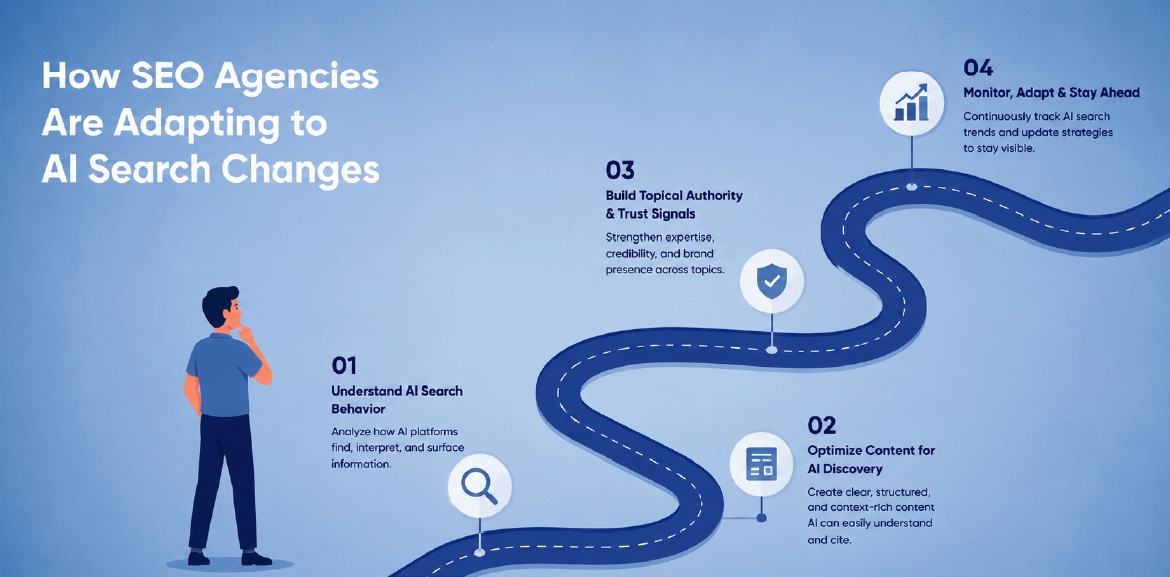
How SEO Agencies Are Adapting Their Strategy
The best agencies are not fighting these changes. Instead, they are turning them into an advantage. Here is how a forward-thinking team helps brands adapt SEO strategy for AI search.
1. Creating Citation-Worthy Content
AI systems favor content that is clear, factual, and well structured. Therefore, agencies now write concise answers, add original data, and format pages so machines can quote them easily. Guides, FAQs, and expert explanations perform especially well.
2. Building Entity and Brand Authority
AI models reward brands they recognize and trust. Because of this, agencies focus on consistent branding, credible backlinks, author expertise, and mentions across the web. Strong E-E-A-T signals (Experience, Expertise, Authoritativeness, Trust) now directly influence whether AI tools cite you.
3. Doubling Down on Structured Data
Schema markup helps search engines and AI models understand your content. As a result, agencies apply structured data more aggressively to products, articles, reviews, and FAQs, which improves the odds of being surfaced in rich results and AI answers.
4. Optimizing for Intent, Not Just Keywords
Modern AI search optimization services move beyond keyword stuffing. Instead, they map content to real user intent, answering the full question a searcher is trying to solve. This approach satisfies both AI summaries and human readers.
5. Tracking New Metrics
Since many searches end without a click, traffic alone no longer measures success. Consequently, agencies now track brand mentions, citation frequency, AI visibility, and assisted conversions alongside rankings. You can see how this thinking has evolved in this overview of the latest SEO strategies used by top agencies.
What This Means for Your Brand
You might wonder whether SEO still matters. The short answer is yes, more than ever. AI search rewards the same fundamentals that good SEO always required: helpful content, technical health, and genuine authority.
However, execution has changed. A brand relying only on informational blog traffic may see declines, while a brand cited inside AI answers gains fresh visibility and higher-intent visitors. Studies in 2026 note that AI-referred users often arrive with more context and convert better.
Transactional and commercial searches remain a strong opportunity too. When someone wants to compare providers or request a quote, the top organic position still drives meaningful clicks. A balanced strategy, therefore, protects both your informational and commercial goals.
To understand how these channels fit together, this comparison of the difference between SEO and performance marketing offers a helpful starting point.

How to Choose the Best SEO Agency in 2026
Not every agency has adapted. When you evaluate partners, look for a few clear signals.
AI-first thinking. Ask how they optimize for AI Overviews, GEO, and AEO, not only rankings.
Modern reporting. The best SEO agency 2026 tracks citations and AI visibility, not just traffic.
Content depth. Look for original research, structured content, and real expertise.
Proven results. Request case studies that show adaptation, not outdated tactics.
By using these filters, you can separate agencies that talk about AI from those that truly deliver AI search optimization services.
Frequently Asked Questions
1. Is traditional SEO dead in 2026? No. SEO has evolved rather than disappeared. Core fundamentals like quality content, technical health, and authority now power both rankings and AI citations.
2. What is GEO in SEO? GEO stands for Generative Engine Optimization. It focuses on getting your content featured and cited inside AI-generated answers such as Google AI Overviews.
3. How do I get my brand cited in AI Overviews? Create clear, factual, well-structured content, add schema markup, and build strong brand authority. AI systems tend to cite trusted, easy-to-parse sources.
4. Do I still need SEO if AI answers everything? Yes. AI models pull answers from web content, so your pages must be optimized to become those sources. Without SEO, you stay invisible.
5. What should I look for in an SEO agency for AI search? Choose a partner that optimizes for AI Overviews and voice search, tracks AI visibility, and proves results with recent, relevant case studies.
Stay Visible in the Age of AI Search
AI is rewriting the rules of search, but visibility is still within your reach. With the right strategy, your brand can appear where your customers now look, whether that is Google, ChatGPT, or a voice assistant.
At Techinfinity, we help brands adapt SEO strategy for AI search with citation-ready content, strong authority signals, and future-focused optimization. If you want to stay ahead in 2026 and beyond, we are ready to help.
Explore our SEO services or reach out at info@techinfinity.io to book a free consultation, and let us make your brand impossible to ignore in AI search.
Reviewed by: TechInfinity Content Team
Last Updated:
This article follows our Editorial Policy and Content Review Process to ensure accuracy and relevance.