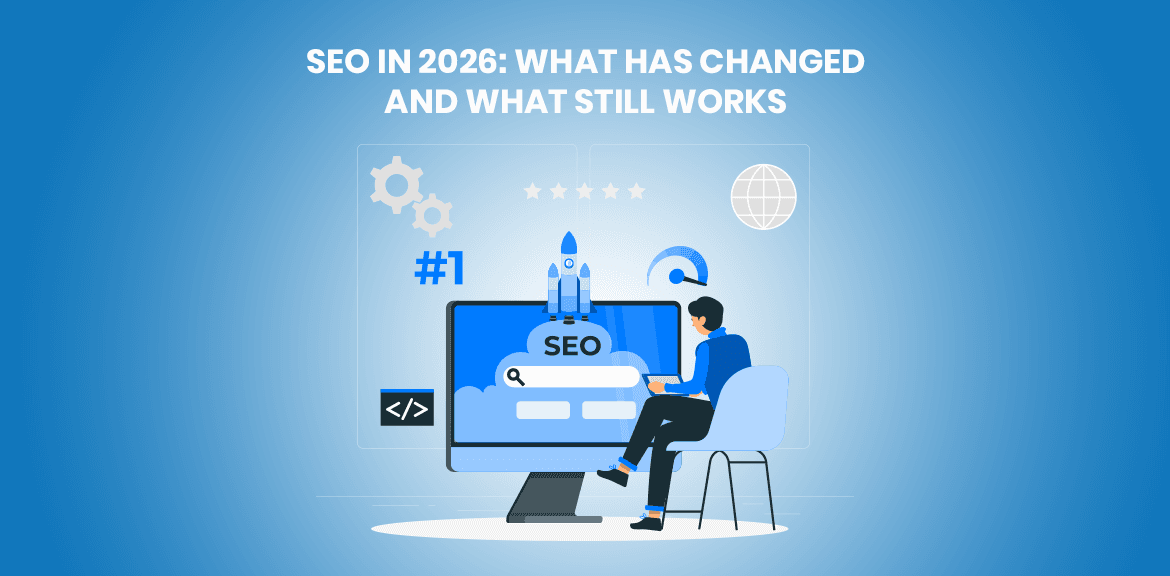
Anyone who has spent even a couple of years in the SEO space knows one thing for sure: the rules never sit still. Step into 2026, and the shift feels sharper than usual. AI overviews, zero-click answers, and a Google that increasingly behaves like a chat-first assistant have rewritten a lot of the playbook. And yet, some things haven't changed a bit. Good content still wins. Fast, well-built websites still rank. Trust still matters.
For business owners, marketers, and agencies alike, the real question isn't "Is SEO dead?" That debate got tired years ago. The real question is this: what actually deserves your time in 2026, and what was just hype? This blog breaks down the SEO trends 2026 has brought front and centre, what the future of SEO really looks like, and the latest SEO strategies you should be folding into your monthly workflow right now.
What Has Actually Changed in SEO This Year
1. AI moved from the back office to the search result itself. A few years ago, AI mostly helped SEOs behind the scenes, writing briefs, clustering keywords, and analysing log files. In 2026, AI is the search result for most informational queries. Google's AI Overviews, Gemini, ChatGPT Search, and Perplexity have pulled a huge chunk of discovery away from the classic blue-link model. Your content now competes to be cited, quoted, and summarised by a machine that essentially speaks on your behalf.
2. Search has gone conversational and multi-platform. Users no longer open only Google. They ask ChatGPT for product comparisons, scroll Reddit for honest reviews, and watch a YouTube Short before booking a restaurant. Ranking on Google alone is no longer a complete strategy; it is one piece of a much wider visibility puzzle.
3. Intent and context beat keywords. Search engines now read pages through the lens of topic depth, entity relationships, and user intent signals. Writing around a single keyword is out. Writing to fully answer a reader's real question is in.
4. E-E-A-T has real teeth. The "Experience" signal now carries the heaviest weight in most industries. First-hand case studies, original photos, author credentials, and visible client work are what separate a page that ranks from one that quietly gets ignored.
5. Zero-click searches keep rising. A meaningful share of queries never results in a click. That changes the KPI; now, value brand mentions, AI citations, and featured snippets matter almost as much as the click itself.
What Still Works (And Probably Always Will)
Before anyone panics and rebuilds their entire strategy, plenty of classic SEO moves are quietly doing the heavy lifting in 2026:
Genuinely helpful content. A well-researched, well-structured piece that actually solves a problem outperforms thin, AI-generated filler — every single time.
Technical hygiene. Fast load speeds, clean mobile experience, crawlable architecture, and smart internal linking. Boring? Yes. Essential? Absolutely.
Backlinks from real, respected sources. Digital PR, guest contributions, and unlinked brand mentions still move the needle meaningfully.
Local SEO. For service-based businesses, an optimised Google Business Profile, consistent NAP data, and steady reviews remain the fastest route to qualified leads.
User experience signals. Pages that people actually stay on, scroll through, and come back to are the ones search engines reward.
The Latest SEO Strategies Worth Your Attention
Here is a practical checklist of SEO best practices for 2026 that we see delivering real results for clients:
Optimise for AI, not just Google. Structure content so large language models can lift clear answers straight out of it. Short summary paragraphs, crisp definitions, and clean H2/H3 hierarchies help enormously.
Build topical authority, not keyword silos. Pick a handful of core themes your brand should own and publish deeply around them — pillar pages, clusters, supporting blogs, and FAQs that all link cleanly to each other.
Invest in original assets. Proprietary data, unique frameworks, original imagery, and real case studies are exactly what AI tools cannot easily replicate. That is now your moat.
Use schema generously but smartly. FAQ, HowTo, Product, LocalBusiness, and Organization schema help search engines and AI systems understand what your page really is.
Diversify your search footprint. Show up on YouTube, Reddit, LinkedIn, Quora, and niche industry forums. Being present where your audience actually hangs out is half the battle.
Measure what matters. Rankings alone no longer tell the full story. Track organic conversions, branded searches, assisted revenue, and AI citations wherever you can capture them.
Why the Future of SEO Still Belongs to Real Brands
Zoom out, and the future of SEO isn't about tricking algorithms, it never really was. It is about being the most useful, most trustworthy, and most recognisable option in your category. Whether a user finds you through Google, an AI summary, a social feed, or a podcast mention, the goal stays the same: they should walk away thinking, "These people clearly know what they're doing."
For service providers, especially SEO in 2026, it is less about chasing hacks and more about building a compounding asset. Every blog, page, and backlink quietly stacks up over months into a steady pipeline of inbound leads. At TechInfinity, we help brands pull this together across AI SEO, local SEO, B2B SEO, e-commerce SEO, Shopify SEO, and enterprise SEO, combining the fundamentals that still work with the new-school tactics shaping 2026.
Frequently Asked Questions
Q1. Is SEO still worth investing in during 2026?
Absolutely. Organic search still drives some of the highest-converting, lowest-cost traffic a business can get. The channels have diversified, but the long-term value of ranking well has not dropped; if anything, it compounds harder as ad costs rise.
Q2. Will AI tools replace traditional SEO?
AI is changing how SEO is done, not whether it is needed. Strategy, brand positioning, content quality, technical health, and link building still need human judgement; AI just speeds up the workflow around them.
Q3. What is Generative Engine Optimisation (GEO)?
GEO is the practice of shaping your content so AI tools like ChatGPT, Gemini, Perplexity, and AI Overviews surface you as a source. Think of it as SEO for machine-generated answers. It lives alongside classic SEO, not in place of it.
Q4. How long does SEO take to show results in 2026?
Most brands see early movement in 3 to 6 months and meaningful traction in 6 to 12. Local SEO tends to move faster; competitive national or e-commerce niches usually take longer.
Q5. What is the single biggest SEO trend in 2026 that small businesses should act on? Double down on local SEO and review marketing. For most service businesses, that combination still delivers the fastest, most measurable return of anything you can do in a given quarter.
Reviewed by: TechInfinity Content Team
Last Updated:
This article follows our Editorial Policy and Content Review Process to ensure accuracy and relevance.