The way people search online is changing faster than ever. Just a few years ago, ranking on page one of Google was the primary goal. Today, businesses need to understand not just traditional SEO, but also generative engine optimisation and AI-powered search experiences.
If you are a business owner or marketer trying to stay visible online in 2026, this guide breaks down exactly what SEO, GEO, and AI Search mean for your business and what you should do about them right now.
The Search Landscape Has Fundamentally Shifted
Google, Bing, Perplexity, and ChatGPT have each introduced AI-powered search features that no longer simply list ten blue links. Instead, they generate direct answers, synthesize multiple sources, and surface content in entirely new ways. This shift has created three distinct but interconnected disciplines that every business must understand.
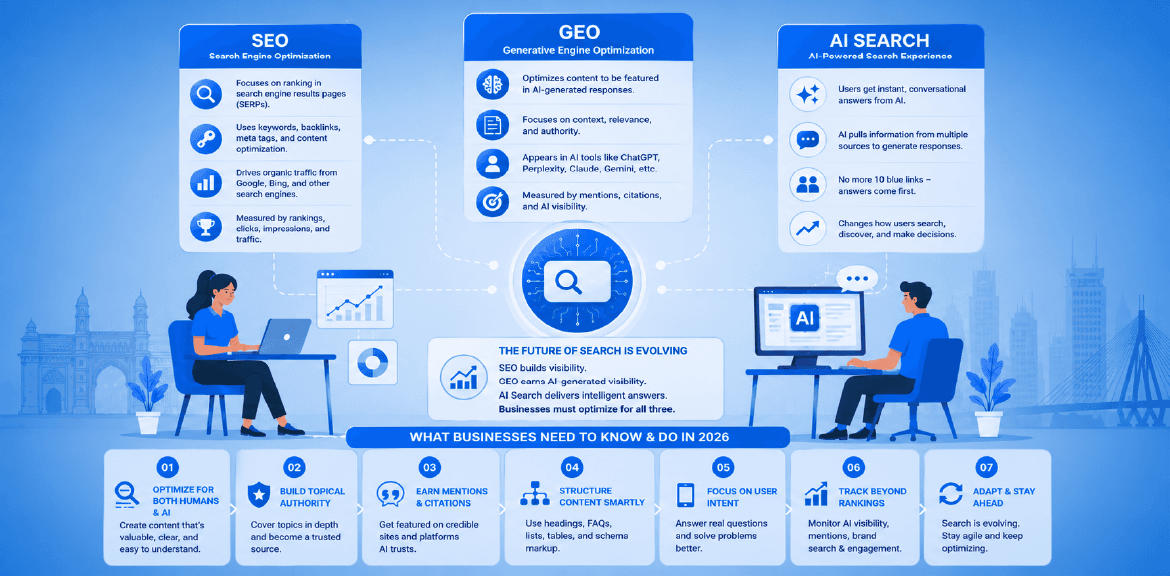
SEO - Foundation Traditional search optimization. Rankings, keywords, backlinks, and technical site health. | GEO - Emerging Generative Engine Optimization. Getting your content cited by ChatGPT, Perplexity, and Gemini. | AI Search - Critical Optimization for Google AI Overviews, which appear above organic results for millions of queries. |
What Is SEO vs GEO? Understanding the Core Difference
Traditional SEO focuses on optimizing your website so search engines rank your pages higher. It involves on-page optimization, technical performance, domain authority, and keyword targeting.
Generative Engine Optimization, or GEO, takes a different approach. Instead of optimizing for a ranked list, you optimize your content so that AI language models cite, quote, or summarize it when generating answers. The goal shifts from ranking on page one to becoming the source an AI trusts.
Factor | Traditional SEO | GEO (Generative Engine Optimization) |
Goal | Rank in search result pages | Be cited in AI-generated answers |
Key signals | Backlinks, keywords, page speed | Authority, factual accuracy, clarity |
Target platform | Google, Bing organic results | ChatGPT, Perplexity, Gemini, AI Overviews |
Content format | Long-form, keyword-rich pages | Direct answers, structured data, FAQs |
Measurement | Rankings, organic traffic | AI citations, brand mentions, referrals |
Google AI Overviews: What They Mean for Your Traffic
Google AI Overviews now appear at the very top of search results, often above all organic listings, directly answering the user query using content pulled from multiple websites.
For businesses this creates both a challenge and an opportunity. Users may find their answer without clicking through, but if Google selects your content as a source, you gain significant credibility and a measurable traffic boost.
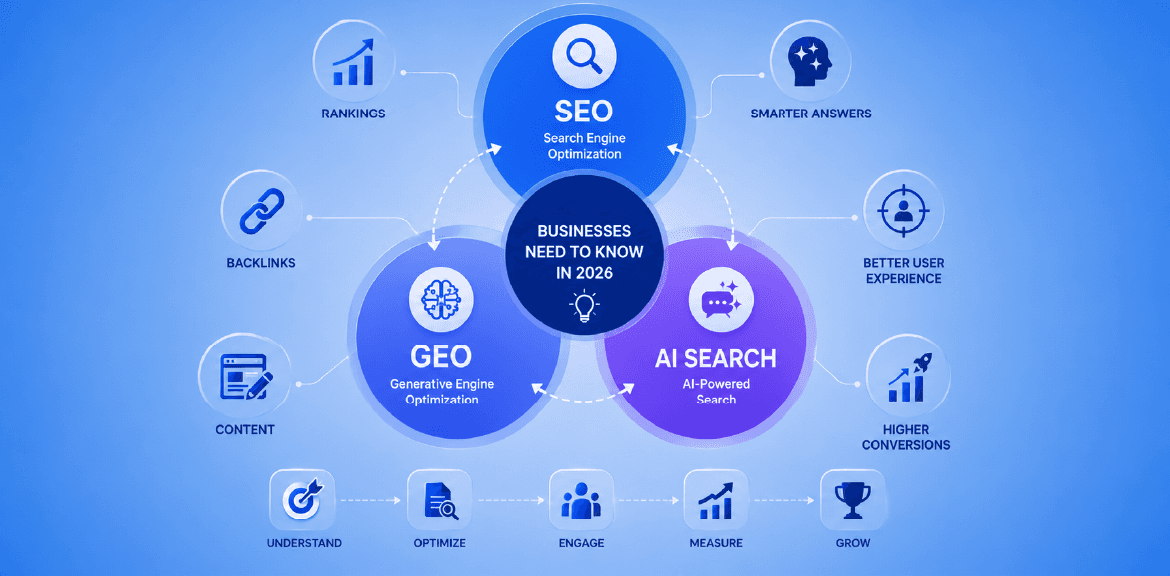
How to Get Featured in Google AI Overviews
Getting featured requires strong traditional SEO and GEO signals combined. Your content needs to be authoritative, clearly structured, and directly answer specific questions.
• Write clear, concise answers to specific questions near the top of your content.
• Use structured data and schema markup such as FAQ, HowTo, and Article schema.
• Maintain strong E-E-A-T signals: Experience, Expertise, Authoritativeness, and Trustworthiness.
• Ensure your site loads quickly and is mobile-friendly.
• Build topical authority by publishing comprehensive content clusters around your core subjects.
AI Search Optimization: The New Ranking Playbook
AIF Search Optimization is the broader practice of making your content visible and trustworthy across all AI-powered search surfaces, not just Google. This includes optimizing for Perplexity AI, Microsoft Copilot, ChatGPT search, and Gemini.
Each platform uses slightly different signals, but the underlying principles remain consistent. AI systems favor content that is factually accurate, well-sourced, clearly written, and structured for easy comprehension.
Core AI Search Ranking Factors in 2026
Understanding these factors helps you prioritize where to invest your content and technical efforts:
• Factual accuracy and citations: AI systems cross-reference claims. Content citing credible sources performs better.
• Content freshness: AI models increasingly weight recently updated content for fast-moving topics.
• Structured clarity: Headers, bullet points, tables, and FAQ sections make content easier for AI to parse and quote.
• Brand authority signals: Mentions across the web, Wikipedia entries, and consistent NAP data all build AI trust.
• Passage-level relevance: AI pulls specific passages, so every section needs to stand on its own.
• llms.txt compliance: A new emerging standard that tells AI crawlers which parts of your site they can use.
Generative Engine Optimization: A Practical Starting Point
GEO does not require starting from scratch. If your website already has solid SEO foundations, the key is to layer GEO-specific improvements on top of what you have already built.
Start by auditing your most important pages and asking: if an AI model read only this page, could it extract a clear, accurate, quotable answer? If no, that page needs a GEO revision.
Practical steps to begin today:
• Add a dedicated FAQ section to every key page.
• Incorporate direct-answer paragraphs at the top of each article.
• Use schema markup consistently across your site.
• Build a robust internal linking structure that signals topical depth to both search engines and AI crawlers.
Why Businesses Cannot Afford to Ignore This Shift
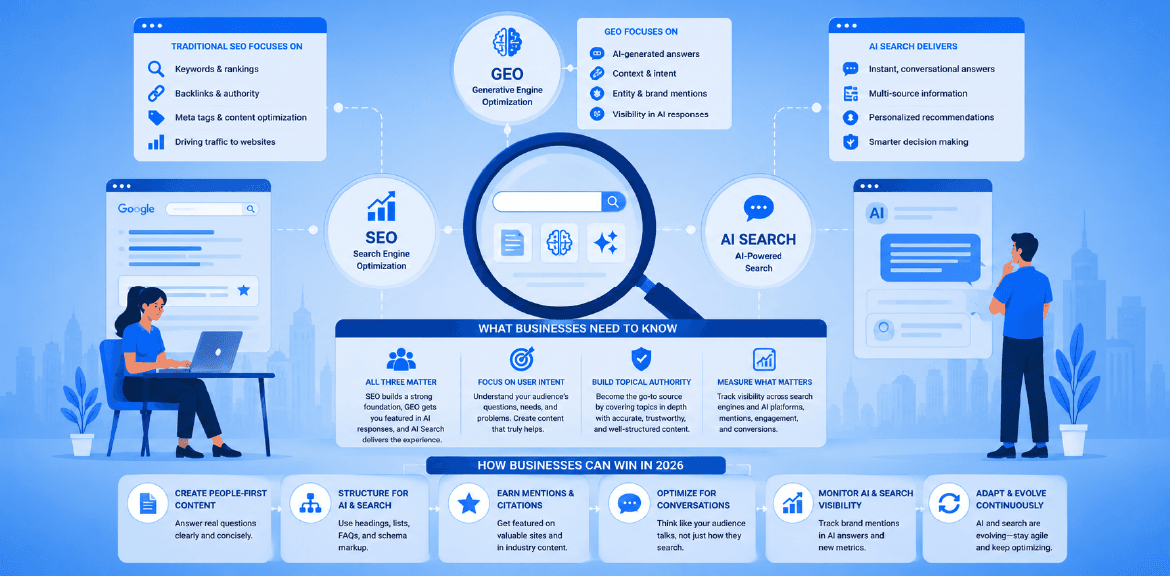
Businesses not appearing in AI Overviews experienced an average 18 to 27 percent drop in click-through rates on queries where AI Overviews were present (early 2026 data).
The businesses gaining ground are those treating SEO, GEO, and AI Search Optimization as a unified strategy rather than separate silos.
Frequently Asked Questions
What is the difference between SEO and GEO?
SEO focuses on ranking your web pages in traditional search engine results. GEO focuses on getting your content cited inside AI-generated answers from tools like ChatGPT, Perplexity, or Google AI Overviews. Both are important in 2026.
Do Google AI Overviews hurt website traffic?
They can reduce clicks for some queries, but being cited as a source inside an AI Overview can also drive higher-quality traffic. The key is to optimize for inclusion, not just traditional ranking.
What are the most important AI search ranking factors?
Factual accuracy, content freshness, structured formatting, brand authority, passage-level relevance, and schema markup are the most critical factors AI systems use when selecting content to cite or feature.
How do I start with Generative Engine Optimization?
Begin by adding FAQ sections, direct-answer paragraphs, and structured data to your key pages. Audit your content for factual accuracy, ensure citations are present, and build topical authority through content clusters.
Is traditional SEO still relevant in 2026?
Absolutely. Traditional SEO remains the foundation. Strong domain authority, quality backlinks, and technical performance are prerequisites for performing well in both classic search results and AI-generated answers.
Which AI search platforms should I optimize for?
Prioritize Google AI Overviews first since Google holds the majority of search volume. Then focus on Perplexity AI, Microsoft Copilot, and ChatGPT search, all of which are growing rapidly among professional and research audiences.
Reviewed by: TechInfinity Content Team
Last Updated:
This article follows our Editorial Policy and Content Review Process to ensure accuracy and relevance.